Injection Molding Design Guide: Walls, Ribs, Bosses & Draft
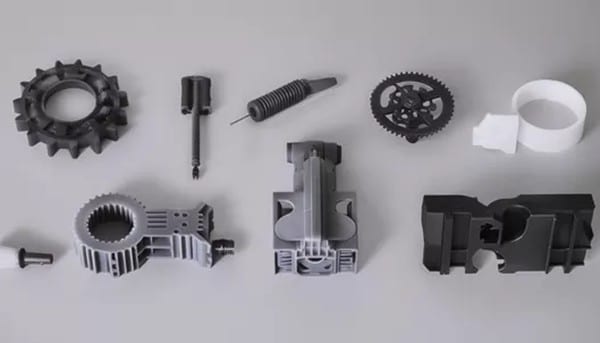
Good injection-molded parts start with molding-friendly design: keep walls uniform and thin (usually 1.5–3 mm), make ribs 40–60% of the wall thickness, add 1–2° of draft on every vertical face, and round internal corners. These rules prevent sink marks, warping and short shots and keep tooling simple. Here's the DFM checklist for injection molding.
See our rapid tooling & injection molding service, or start with what is injection molding.
Key takeaways
- Uniform wall thickness (typically 1.5–3 mm) is the #1 rule — uneven walls cause sink marks and warping.
- Ribs should be 40–60% of the wall thickness (thicker ribs sink); use ribs instead of thick sections for stiffness.
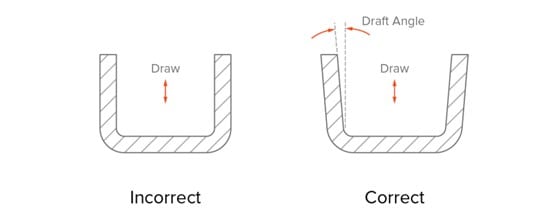
- Draft angle of 1–2° on all vertical faces lets the part release from the mold cleanly.
- Round internal corners (radius ≥ 0.5× wall) to reduce stress and improve flow.
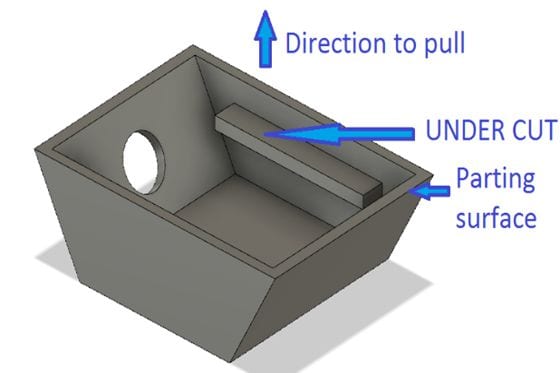
- Avoid undercuts where possible — they need side-actions/lifters that raise tooling cost.
- Get a free DFM review with your quote.
Injection molding design rules at a glance
| Feature | Guideline |
|---|---|
| Wall thickness | Uniform, typically 1.5–3 mm (material-dependent) |
| Rib thickness | 40–60% of the adjoining wall; height ≤ 3× wall |
| Boss diameter | ~2× the hole/screw diameter; support with ribs/gussets |
| Draft angle | 1–2° minimum on vertical faces (more for texture) |
| Internal radii | ≥ 0.5× wall thickness |
| Undercuts | Avoid, or plan for side-actions/lifters |
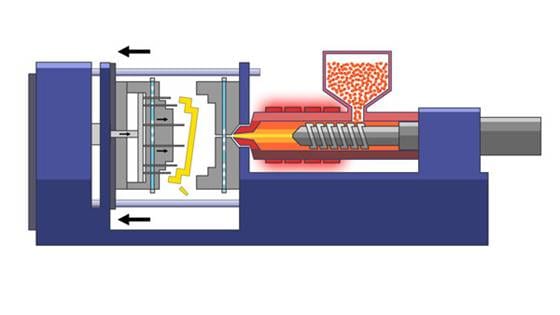
1. Uniform wall thickness
Uniform walls are the foundation of a good molded part. As the plastic cools, thick sections shrink more than thin ones, pulling the surface inward (sink marks) and creating internal stress that causes warping. Keep walls as uniform as possible and within the material's recommended range (commonly 1.5–3 mm). Where a thickness change is unavoidable, blend it gradually.
2. Ribs for stiffness
Need more stiffness? Add ribs rather than thickening the wall. Keep rib thickness to 40–60% of the wall (thicker ribs cause sink on the opposite face), height under about 3× the wall, and add draft and a small base radius.
3. Bosses for fasteners
Bosses accept screws and press-fits. Make the outer diameter about twice the screw/hole diameter, keep the wall of the boss within the thin-wall rule (attach with ribs or gussets rather than a thick base), and add draft.
4. Draft angle
Every face parallel to the mold's pull direction needs draft — a slight taper (1–2° minimum) so the part ejects without drag marks or sticking. Textured surfaces need more (roughly 1° per 0.025 mm of texture depth). See our draft angle guide.
5. Radii and corners
Sharp internal corners concentrate stress and disrupt material flow. Add an internal radius of at least half the wall thickness; keep the outer radius equal to the inner radius plus the wall to hold uniform thickness around the corner.
6. Undercuts and side-actions
Undercuts (snaps, side holes, threads) prevent straight ejection and require side-actions, lifters or collapsible cores that add tooling cost. Design them out where you can, or flag them early so tooling is planned properly.
Design also drives cost and quality
Molding-friendly design lowers tooling cost, shortens cycle time and cuts scrap. Our engineers review every part for manufacturability. See common molding defects & fixes and injection molding materials.

Frequently asked questions
What is the ideal wall thickness for injection molding?
Why do injection-molded parts need draft?
How thick should ribs be?
What causes sink marks?
Should I avoid undercuts?
Sources & further reading: MatWeb — plastic material properties · ISO 2768 general tolerances.
Manufacturing next step
Apply this guidance to your part
Continue to the relevant service page for process scope and buyer inputs. If your design is ready, send the current files for engineering review and quotation.
Related manufacturing resources
Continue with the process or project stage most relevant to this topic: