Skip to content
Sendot Technology

How to Write an RFQ That Gets an Accurate Machining Quote
Ms. Zhangยท Senior Project EngineerJuly 25, 2026
How to Write an RFQ That Gets an Accurate Machining Quote

TL;DR

A complete machining RFQ tells the supplier exactly what to build, to what tolerance, in what quantity, and how it will be inspected. Send a 3D model AND a 2D drawing, name the material grade and acceptable substitutes, flag only the tolerances that matter, and state quantity plus likely repeat volume. Each missing item is either padded for risk or bounced back as a question that costs days.

  • Two files, not one: a STEP model shows geometry; a 2D drawing shows intent, tolerances and datums.
  • Tolerance discipline: blanket-tight tolerancing is the single biggest avoidable cost driver on a CNC quote.
  • Quantity honesty: state one-off vs likely repeat so the supplier prices the right process, not the wrong one.
  • Same package to every supplier: identical inputs are the only way quotes are comparable.
  • Sendot turnaround: a complete RFQ is quoted within 12 hours; an incomplete one starts a clarification round.

You send an RFQ to three suppliers. One quotes in a day, one takes a week and comes back with four questions, and the third quotes fast but 40% higher. You can't tell which is the real price because you gave each of them something slightly different. That is not a supplier problem. That is an RFQ problem.

A request for quotation is a procurement document, not a file attachment. Its job is to make a supplier's estimator confident enough to commit a number without guessing. Every gap in the RFQ becomes either a guess priced high for safety, or a question that adds days. This guide covers exactly what belongs in a machining RFQ package, why each item is there, and what a missing item does to the quote you get back.

Two adjacent topics are covered elsewhere and are not repeated here: the mechanics of submitting a request and what moves the price live in how to get an instant CNC machining quote, and the CAD file specifics โ€” formats, exporting, watertight geometry โ€” live in how to prepare CAD files for a CNC quote. This article is about the package as a whole: completeness and comparability.

The quick answer: what a complete RFQ contains

A machining RFQ that gets an accurate, first-pass quote contains nine things. Miss any one and the estimator either pads the price or asks you a question.

  1. 3D model (STEP preferred) โ€” the geometry that gets machined.
  2. 2D drawing (PDF) โ€” tolerances, datums, critical features and intent the model cannot carry.
  3. Material grade and acceptable substitutes โ€” the exact alloy, plus what you will and won't accept instead.
  4. Critical vs general tolerances โ€” which few features are tight, and a general tolerance for everything else.
  5. Surface finish and treatment โ€” machined finish (e.g. Ra 0.2 ยตm), plus anodising, plating or painting.
  6. Quantity and likely repeat volume โ€” this order, and whether it repeats.
  7. Inspection and documentation โ€” FAI, CMM report, material certificates.
  8. Target date โ€” when you need parts in hand.
  9. Compliance and packaging โ€” RoHS/REACH, marking, export packaging, Incoterms.

The rest of this guide takes each of these and explains what it costs you when it's absent.

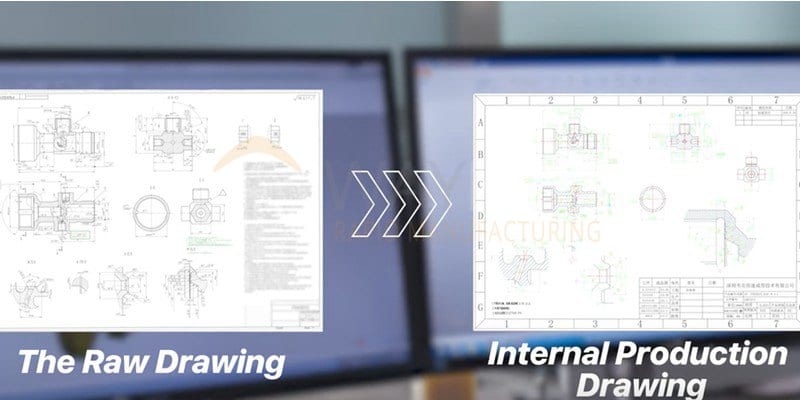
Engineer interpreting a 2D machining drawing alongside a 3D CAD model for an RFQ
A 3D model shows what the part looks like; the 2D drawing tells the machinist what actually matters.

Why the model alone is not enough

The most common RFQ mistake is sending only a STEP file. A 3D model is a perfect description of nominal geometry and nothing else. It carries no tolerances, no datum references, no surface-finish callouts, no thread specifications you can rely on, and no indication of which faces are functional and which are cosmetic. The model says "this is the shape." It does not say "this bore has to be H7 and everything hangs off it."

When a supplier receives a model with no drawing, one of two things happens. A careful supplier emails you back asking for tolerances, material and finish โ€” a clarification round that typically costs two to four days before you even have a number. A careless supplier assumes standard tolerances everywhere, quotes low, and then the parts come back out of spec on the one feature you cared about, because you never told them it was critical. Both outcomes are worse than spending twenty minutes on a drawing.

Model-based definition (a fully annotated 3D model with PMI) does exist and can replace a 2D drawing, but only if your PMI is complete and the supplier's CAM chain reads it. For most cross-border RFQs, a plain PDF drawing on top of the STEP file is faster, unambiguous and universally readable. Send both. The ISO 128 drawing conventions and ASME Y14.5 GD&T standards exist precisely so a drawing means the same thing in Guangzhou as it does in Stuttgart.

Inspection report โ€” the documentation an RFQ should request up front

What each item does to your quote

Here is the core of it: the RFQ checklist as a working table. Read the third column โ€” that is what an omission actually costs.

RFQ itemWhy the supplier needs itWhat a missing item does to the quote
3D model (STEP)Generates toolpaths; drives machining time and stock size.No quote possible; immediate bounce-back.
2D drawing (PDF)Defines tolerances, datums, threads, critical features.Estimator guesses intent โ€” either a clarification round or wrong parts.
Material gradeSets stock cost, machinability, tool wear.Priced on an assumed grade; real grade changes cost and lead time.
Acceptable substitutesLets supplier use in-stock equivalent, saving time and money.Supplier sources the exact spec at a premium, or delays waiting for it.
Critical tolerancesTells the machinist where to slow down and inspect.Either everything toleranced tight (over-priced) or the key feature missed.
General toleranceCovers all unmarked dimensions with one rule.Estimator assumes the tightest reasonable class โ€” padding built in.
Surface finish / treatmentAdds machining passes plus outside processing steps.Finishing left out of the price, then added later as a surprise.
QuantityDrives per-part price and process choice.Cannot price; per-part cost is meaningless without it.
Repeat volumeDecides one-off machining vs tooling-based process.Wrong process quoted; you overpay now or can't scale later.
Inspection / docsFAI, CMM and certs add real inspection hours.Priced without inspection; certs you assumed you'd get aren't included.
Target dateDetermines scheduling and any expedite cost.Quoted on standard lead time; your deadline surfaces too late.
Compliance / packagingRoHS/REACH docs, marking, export packing.Cost and time added after the fact; possible re-quote.

Material grade and substitutes

"Aluminium" is not a material. 6061-T6 and 7075-T6 differ in price, machinability and strength; a supplier quoting on the wrong assumption gives you a number you can't use. Name the grade. Then, separately, tell the supplier what substitutes you accept. If 6061-T6 and 6082-T6 are functionally interchangeable for your part, saying so lets the supplier quote whichever is in stock โ€” often faster and cheaper. If nothing but the exact grade will do, say that too, so no one assumes flexibility you don't have. Sendot machines 30+ materials; the more precisely you name the grade, the tighter the quote.

Critical vs general tolerances โ€” the top avoidable cost

This is where most money is wasted before a single chip is cut. Applying a tight tolerance to every dimension โ€” "ยฑ0.01 mm all over" because it feels safe โ€” is the single biggest avoidable cost driver on a machining quote. Tight tolerances mean slower feeds, more passes, more in-process inspection, higher scrap and sometimes a grinding operation instead of a milling one. Most of a typical part does not need it.

Do the opposite. Identify the handful of features that are actually functional โ€” the bearing bore, the mating face, the dowel-pin holes โ€” and tolerance those tightly. Sendot holds ยฑ0.05 mm on critical features and Ra 0.2 ยตm where required. Then put a sensible general tolerance in the title block (an ISO 2768-m or -f class, for instance) so every unmarked dimension is covered by one rule. A drawing that marks three critical dimensions and defers the rest to a general class quotes far lower than one that is silently tight everywhere โ€” and it inspects faster too.

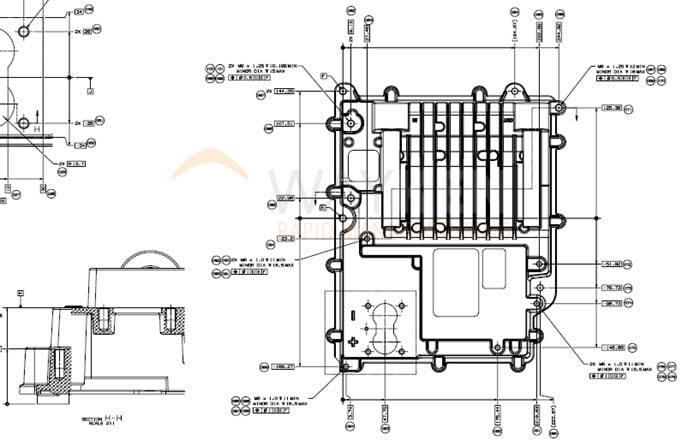
Close-up of a machining drawing showing tight-tolerance small holes flagged as critical features
Flag the few features that are truly critical โ€” like these small holes โ€” and let a general tolerance cover the rest.

Quantity and, crucially, repeat volume

Quantity sets the per-part price, so an RFQ without it can't be priced at all. But repeat volume changes the process. A one-off prototype is best machined; a part you'll order 2,000 of every quarter may be cheaper cast or moulded with tooling. Die casting at Sendot carries a tooling-based MOQ of 1,000โ€“3,000 pcs, while CNC and sheet metal have no MOQ. If you tell the supplier "50 now, likely 3,000/year if it works," a good estimator can quote the prototype on CNC and flag the tooling path for volume โ€” so you don't machine 3,000 parts one at a time next year at ten times the unit cost.

Surface finish, inspection and documentation

State the machined finish and any treatment โ€” anodising, plating, powder coat, bead blast โ€” because treatments are outside operations with their own cost and lead time. Then state inspection needs explicitly. A first-article inspection (FAI) report, full-dimensional CMM data, or material certificates each add real hours and belong in the price up front. Sendot provides CMM inspection, FAI reports and material certificates under its ISO 9001 system โ€” but only what you ask for gets quoted. If your part feeds a medical or automotive program with its own quality-system requirement (ISO 13485, IATF 16949), name that requirement in the RFQ so the supplier can confirm which documents it can supply for your supply chain, rather than discovering the gap at PPAP.

A worked RFQ: the step-by-step

Here is a repeatable way to assemble the package so nothing slips.

  1. Export the model. STEP (AP214) is the safe default; Sendot also reads IGES, X_T, DWG, PDF, STL, and DXF for 2D laser parts. Details in the CAD-prep guide.
  2. Make the 2D drawing. One page is fine. Title block with material, general tolerance, finish and units. Mark only the critical dimensions and datums. Call out threads and any special features.
  3. Write the line items. Grade + acceptable substitutes, quantity + repeat volume, surface treatment, inspection/documents, target date, compliance and packaging. One short paragraph.
  4. State your assumptions. Units (mm), Incoterms (e.g. FOB or DAP your city), and that quotes should include tooling if any. Stating assumptions is what makes quotes comparable.
  5. Send the identical package to each supplier. Same files, same line items, same assumptions. If you tell one supplier the repeat volume and not another, their quotes are no longer comparable.
  6. Give a decision date. "Quotes by Friday" sets a clock and tells you who is responsive before you commit a program to them.

What a good RFQ email actually looks like

You don't need a portal or a form. A clear email does the job:

Subject: RFQ โ€” Bracket, 6061-T6, qty 50 (likely 3,000/yr)

Attached: bracket_revB.step and bracket_revB.pdf (drawing).

  • Material: 6061-T6. Substitute 6082-T6 acceptable.
  • Tolerances: two critical (bore ร˜12 H7, top face flatness 0.02) called out on the drawing; general ISO 2768-m.
  • Finish: clear anodise, Type II.
  • Quantity: 50 now; likely 3,000/year if approved โ€” please flag a tooling path if cheaper at volume.
  • Inspection: FAI report + material cert required.
  • Need parts by: 20 Aug. Ship DAP Chicago.
  • Please quote by Fri and state your assumptions.

That message can be quoted accurately without a single follow-up question. Sendot quotes a package like this within 12 hours of receiving the CAD. You can send the same block to Protolabs, Xometry, Hubs or Fictiv and get numbers that actually line up โ€” because the inputs are identical.

Making quotes comparable across suppliers

Accuracy is one goal; comparability is the other. Three quotes are only comparable if three things are true: every supplier received the same files, the same line items, and the same stated assumptions. Comparability breaks in quiet ways. One supplier quotes ex-works and another quotes delivered, so the cheaper-looking one isn't. One assumed no material cert and priced it out; another included it. One quoted the exact grade; another used a substitute you hadn't authorised. When the numbers come back, put them in a table normalised to the same Incoterm, the same certs and the same grade before you compare. If a quote is far lower, the usual reason is that the supplier left something out โ€” read their assumptions before you celebrate. Who you send the RFQ to matters as much as what's in it; vetting the supplier itself is covered in how to vet an overseas CNC supplier.

Common mistakes that cost you days or money

  • Model only, no drawing. Forces the estimator to guess intent. The number-one cause of clarification rounds.
  • Tight tolerances everywhere. The biggest avoidable cost. Tolerance the few features that matter, general-class the rest.
  • "Aluminium" with no grade. Un-quotable without an assumption; the assumption may be wrong.
  • No repeat volume. Supplier prices the wrong process; you overpay now or can't scale.
  • Inspection assumed, not stated. FAI and certs you expected aren't in the price, then appear as a surprise.
  • Different package to each supplier. Quotes look different because the inputs were different, not the suppliers.
  • No Incoterm. You compare an ex-works price against a delivered one and pick wrong.
  • Asking about duties from the supplier. Import duty and VAT are yours to determine as importer of record; classify the part yourself using your country's tariff schedule (for the US, the USITC HTS; for the EU, TARIC) or a licensed customs broker. Rates change and must be confirmed at time of import โ€” don't ask a machinist to price your landed cost.

Frequently asked questions

Can I get a machining quote from just a 3D model?
You can get a rough one, but not an accurate one. A model carries geometry only โ€” no tolerances, datums, finish or critical-feature callouts. The supplier either guesses (and pads the price or makes wrong parts) or asks for a drawing, costing days. Send a 2D drawing with the model; it takes twenty minutes and removes the biggest source of quoting error.
Why does tolerancing everything tightly raise the price so much?
Tight tolerances mean slower cutting, more passes, more in-process measurement, higher scrap, and sometimes an extra grinding operation. Applied to every dimension, that cost multiplies across the whole part even though most features don't need it. Flag only the functional features โ€” bores, mating faces, dowel holes โ€” and let a general tolerance class cover the rest. It's the single largest avoidable cost driver on a CNC quote.
Should I tell the supplier my likely repeat volume?
Yes. Repeat volume decides the process. A one-off is machined; thousands per year may be cheaper cast or moulded with tooling. State "50 now, likely 3,000/year" and a good estimator quotes the prototype on CNC while flagging a tooling path for volume. At Sendot, CNC and sheet metal have no MOQ; die casting is tooling-based at 1,000โ€“3,000 pcs.
How do I make quotes from different suppliers comparable?
Send every supplier the identical package โ€” same files, same line items, same stated assumptions including material grade, inspection requirements and Incoterm. When quotes return, normalise them to the same terms before comparing: same delivery basis, same certs, same grade. A quote that looks far cheaper has usually left something out, so read each supplier's stated assumptions before deciding.
Can the supplier tell me the import duty on my parts?
No โ€” and you shouldn't rely on anyone but the proper source. As importer of record you classify the part under your country's tariff schedule (the USITC HTS in the US, TARIC in the EU) or hire a licensed customs broker. Rates change and depend on classification and origin, so they must be confirmed at the time of import. A machining supplier prices the parts, not your landed cost.

KEY TAKEAWAYS

  • An RFQ is a procurement document โ€” every gap becomes padding or a clarification round.
  • Send a 3D model AND a 2D drawing; the model has no tolerances or intent.
  • Tolerance only the critical features; blanket-tight tolerancing is the top avoidable cost.
  • State quantity and likely repeat volume so the right process gets priced.
  • Name inspection and documentation up front โ€” FAI, CMM and certs add real hours.
  • Send the identical package with stated assumptions to every supplier for comparable quotes.

Get a quote in 12 hours โ†’

A complete RFQ is the cheapest quality tool you own. It costs twenty minutes and it removes the two things that ruin a sourcing cycle: guesswork and back-and-forth. Assemble the package once, send it unchanged to everyone, and the quotes that come back will be accurate and comparable the first time. When your package is ready, send it to Sendot and we'll return a quote within 12 hours.

Explore how Sendot Technology can manufacture your custom parts:

+86 15818870852LUKE@sendottech.com+86 15818870852