Electroplating vs Electroless Plating: Which to Choose
Electroplating uses an electric current to deposit metal — it's fast and low-cost but builds up unevenly on complex shapes (thicker on edges, thin in recesses). Electroless plating uses an autocatalytic chemical reaction with no current, so it deposits a perfectly uniform, harder layer even inside bores and threads — at a higher cost. Here's how to choose between them.
See our parts finishing service, or the electroplating guide and hard chrome vs electroless nickel.
Key takeaways
- Electroplating: electric current deposits metal — fast, inexpensive, many metals (nickel, chrome, zinc, gold), but uneven thickness on complex geometry.
- Electroless plating: a chemical (autocatalytic) reaction — perfectly uniform coverage in bores, threads and blind holes, harder and more wear-resistant, but slower and pricier.
- For complex parts needing even coverage and hardness, choose electroless nickel; for simple parts and lowest cost, choose electroplating.
- Both add corrosion resistance, wear resistance and/or conductivity; electroless nickel can be heat-treated for extra hardness.
- Get plated parts with your machining — request a quote.
Electroplating vs electroless — comparison
| Attribute | Electroplating | Electroless plating |
|---|---|---|
| How it works | Electric current (electrolysis) | Autocatalytic chemical reaction (no current) |
| Thickness uniformity | Uneven — thick on edges, thin in recesses | Very uniform, even in bores & threads |
| Hardness / wear | Good (excellent for hard chrome) | Harder; heat-treatable for more |
| Metals | Nickel, chrome, zinc, gold, copper, etc. | Mostly nickel (Ni-P), some others |
| Speed & cost | Faster, lower cost | Slower, higher cost |
| Best for | Simple parts, decorative, high volume | Complex parts, uniform coverage, wear |
Electroplating
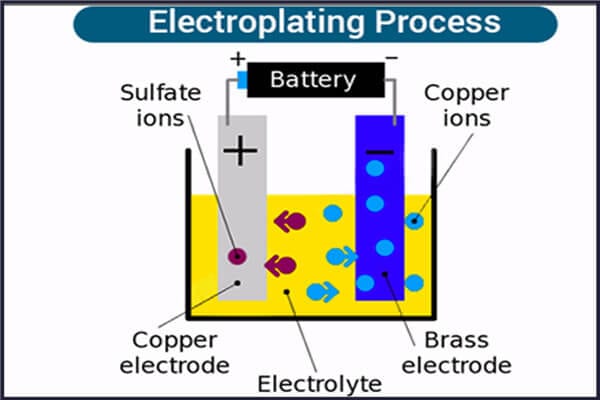
In electroplating, the part is the cathode in a plating bath and an electric current drives metal ions onto its surface. It's fast, works with many metals (nickel, decorative and hard chrome, zinc, gold, copper), and is the most cost-effective choice at volume. The trade-off is throwing power: current concentrates on edges and corners, so the deposit is thicker there and thinner in recesses, holes and internal features.
Electroless plating
Electroless plating (most commonly electroless nickel, a nickel-phosphorus alloy) deposits metal by a chemical reaction on the part surface — no electric current. Because there's no current to concentrate, the coating is remarkably uniform across the entire part, including inside deep bores, blind holes and threads. The deposit is hard and corrosion-resistant, and can be heat-treated to increase hardness further. It costs more and plates more slowly, but it's the right choice when even coverage and hardness matter.
Which should you choose?
- Complex geometry, internal features, threads: electroless nickel — it coats them evenly.
- Maximum hardness / wear on precise parts: electroless nickel (heat-treated) or hard chrome plating.
- Decorative or simple parts, lowest cost, high volume: electroplating.
- Corrosion resistance on steel: zinc electroplating or electroless nickel.
Common specs: ASTM B733 covers electroless nickel; ASTM B633 covers electrodeposited zinc. Compare with anodizing for aluminum parts.

Frequently asked questions
What is the main difference between electroplating and electroless plating?
Is electroless nickel better than electroplated nickel?
Which plating is best for complex parts with holes and threads?
Which is cheaper, electroplating or electroless plating?
Does plating add much thickness?
Sources & further reading: ASTM International (B733 / B633 standards) · Products Finishing — plating reference.
Manufacturing next step
Apply this guidance to your part
Continue to the relevant service page for process scope and buyer inputs. If your design is ready, send the current files for engineering review and quotation.
Related manufacturing resources
Continue with the process or project stage most relevant to this topic: