Laser Cutting vs Punching vs Waterjet for Sheet Metal
TL;DR
Use laser cutting for almost all sheet metal work — it is fastest and most flexible for complex profiles in steel, stainless and aluminum. Use punching when the part is mostly repeated standard holes and the volume is high enough to justify tooling. Use waterjet when the material cannot take heat, is too thick or reflective for the laser, or is not metal at all.
- Laser is the default: complex profiles, no tooling, and a clean edge in the 0.5–6 mm sheet most parts use.
- Punching only wins on repeat standard holes at volume — it needs tooling, and it cannot cut an arbitrary curve.
- Waterjet cuts cold, so there is no heat-affected zone — the reason to pick it for hardened, heat-sensitive, or non-metal material.
- Heat is the real dividing line: laser and plasma leave a heat-affected zone; waterjet does not.
- Thickness decides at the extremes: waterjet keeps going where a fibre laser stops.
- Sendot laser cuts and punches to ±0.1 mm on cut features, no MOQ, simple parts in 3–7 business days.
Every sheet metal part starts as a flat blank that has to be cut out. Which process cuts it changes the edge quality, the tolerance, the cost, and sometimes the metallurgy of the part. This guide is the practical comparison.
See our sheet metal fabrication services, or start with what is sheet metal fabrication.
Side-by-side comparison
| Laser cutting | Punching | Waterjet | |
|---|---|---|---|
| How it cuts | Focused beam melts/vaporises a narrow kerf | Hardened tool shears the metal mechanically | Abrasive-laden water erodes the material |
| Tooling | None — profile is a program | A punch and die per feature | None |
| Best at | Complex profiles, one-offs to mid volume | Repeated standard holes at volume | Heat-sensitive, thick, or non-metal material |
| Geometry | Any 2D profile | Only the shapes you have tools for | Any 2D profile |
| Heat-affected zone | Yes — small but real | None (cold, but deforms locally) | None — cuts cold |
| Edge | Clean, slight dross; may need deburring | Slight roll-over and burr on the exit side | Slightly tapered, matte, no dross |
| Thickness | Excellent through common sheet; drops off when thick | Limited by press force and tool life | Keeps going well past the laser |
| Reflective metals | Copper and brass are harder (fibre lasers cope) | No issue | No issue |
| Speed | Fast on profiles | Fastest on repeat holes | Slowest |
Laser cutting — the default
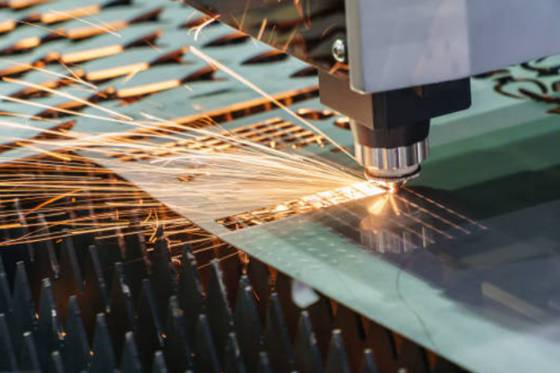
Laser cutting is the right answer for most sheet metal parts. A focused beam cuts a narrow kerf with no tooling at all, so the profile is just a program: an enclosure with 40 different cutouts costs the same to set up as a plain rectangle, and a design change is a file change rather than a new tool.
- No tooling — economic from a single prototype upward.
- Complex profiles — internal cutouts, slots, lettering, tight radii.
- Clean, square edge that usually needs only light deburring.
- Tight tolerance — Sendot holds ±0.1 mm on cut features.
The trade-offs: a small heat-affected zone at the cut edge, where the metal's structure has been altered; efficiency drops as material gets thick; and highly reflective metals like copper and brass are harder to cut (modern fibre lasers handle them, but it is not free).
Punching — repeat holes at volume
Punching shears the metal with a hardened tool, so each hit is essentially instantaneous. On a panel with 200 identical vent holes, a turret punch will finish long before a laser traces 200 circles.
But punching only makes shapes you have tooling for. An arbitrary curve needs either a custom tool or nibbling — stepping a small tool along the path, which is slow and leaves a scalloped edge. It also deforms the metal locally: expect slight roll-over on the entry side and a burr on the exit side.
The honest rule: punching wins when the part is mostly repeated standard features and the volume justifies the tooling. Otherwise the laser's zero-tooling flexibility wins. Many real parts use both — punch the standard holes and hardware locations, laser the profile.
Waterjet — when heat is the problem
Waterjet cuts cold. A high-pressure jet of water carrying abrasive erodes the material away, and because there is no thermal input there is no heat-affected zone at all. That single property is the whole reason to choose it:
- Heat-sensitive material — hardened or tempered metal whose properties a laser's heat would change at the edge.
- Thick material — waterjet keeps cutting well past where a laser becomes uneconomic.
- Reflective metals — copper and brass are no harder than anything else.
- Non-metals — stone, glass, composites, thick plastics.
The trade-offs: it is the slowest of the three, so it costs more per part where a laser would do; the kerf is slightly tapered; and the edge is matte rather than crisp.
What about plasma?
Plasma cutting belongs in the same family: fast and economical on thick conductive metal, but with a wider kerf, a larger heat-affected zone, and looser tolerances than a laser. For the 0.5–6 mm sheet most fabricated parts use, laser beats plasma on precision and edge quality, which is why plasma is mostly a heavy-plate process.
The decision rule
Which cutting process should I use?
- Default → laser cutting. Complex profiles, no tooling, tight tolerance, any volume.
- Mostly repeated standard holes + high volume → punching (or punch the holes, laser the profile).
- Cannot take heat, or too thick, or not metal → waterjet.
- Heavy plate, precision not critical → plasma.
- Not sure → send the CAD. The DFM review picks the process; you do not have to.
In practice you rarely choose in isolation: the cut blank still has to be bent, possibly welded, and deburred. Cutting is one step in a chain, and the process that suits the whole chain beats the one that wins on its own.
Sheet metal cutting at Sendot Technology
Sendot Technology laser cuts, punches, bends, welds and finishes sheet metal in house — so the cutting decision, the bending, and the finish stay with one supplier and one DFM review.
- Processes: laser cutting, punching, press-brake bending, stamping, TIG/MIG/spot welding, hemming, finishing
- Materials: mild & cold-rolled steel, stainless 304/316, aluminum 5052/6061, galvanised steel, copper, brass, typically 0.5–6 mm
- Tolerance: ±0.1 mm on cut features
- Volume: no minimum order — one prototype or a low-volume run
- Lead time: simple laser-cut and bent parts in 3–7 business days
- Quality: ISO 9001 quality system; free DFM review with every quote
Frequently asked questions
Is laser cutting or waterjet better for sheet metal?
When is punching cheaper than laser cutting?
Does laser cutting damage the metal?
What thickness of sheet metal can you cut?
Do laser-cut parts need deburring?
How do I get a sheet metal cutting quote?

Manufacturing next step
Apply this guidance to your part
Continue to the relevant service page for process scope and buyer inputs. If your design is ready, send the current files for engineering review and quotation.
Related manufacturing resources
Continue with the process or project stage most relevant to this topic: