Aluminum Grades for CNC Machining: 6061 vs 7075 vs 5052 vs 2024
For most CNC machined parts, 6061 is the best all-round aluminum grade — a balance of strength, machinability, weldability and corrosion resistance. Choose 7075 when you need maximum strength, 5052 for the best corrosion resistance and forming, and 2024 for high fatigue strength in aerospace parts. This guide compares the four aluminum grades machinists reach for most, so you can pick the right one before you request a quote.
See our CNC aluminum machining service and the aluminum materials hub for capabilities, finishes and tolerances.
Key takeaways
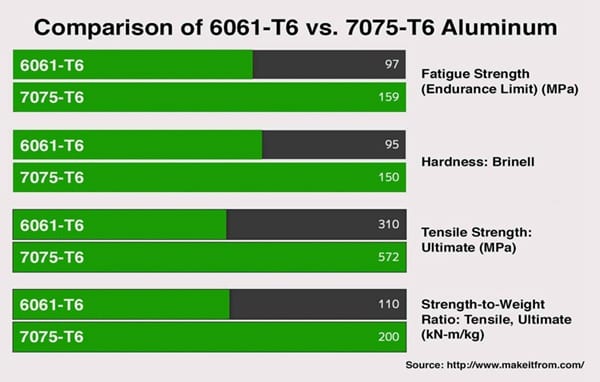
- 6061 is the default choice — versatile, weldable, anodizes well, tensile strength around 310 MPa (T6).
- 7075 is the strongest common grade (tensile around 570 MPa, T6) but is pricier and hard to weld — aerospace and high-stress parts.
- 5052 is non-heat-treatable, extremely corrosion-resistant and very formable — enclosures, marine and sheet parts.
- 2024 offers high fatigue strength for aerospace structure, but has poorer corrosion resistance (often used clad).
- Aluminum machines 3–4× faster than steel and holds tolerances to ±0.01 mm with precision machining.
- Get an exact price with an project-specific quote from your CAD file.
Aluminum grades at a glance
All four grades are heat-treatable except 5052. The table below summarises how they compare for machined parts:
| Grade | Series / main alloying | Typical temper | Tensile strength | Machinability | Corrosion resistance | Relative cost | Best for |
|---|---|---|---|---|---|---|---|
| 6061 | 6000 · Mg + Si | T6 / T651 | ~310 MPa | Good | Good | $ | General parts, brackets, housings, prototypes |
| 7075 | 7000 · Zn + Cu | T6 / T651 | ~570 MPa | Good | Moderate | $$$ | Aerospace, structural, high-stress parts |
| 5052 | 5000 · Mg | H32 (not heat-treatable) | ~228 MPa | Fair (gummy) | Excellent (marine) | $$ | Enclosures, marine, formed sheet parts |
| 2024 | 2000 · Cu + Mg | T3 / T351 | ~470 MPa | Good | Poor (often clad) | $$$ | Aerospace structure, fatigue-critical parts |
6061 aluminum — the versatile all-rounder
6061 is the most widely machined aluminum alloy in the world. Its magnesium-silicon chemistry gives a strong, weldable, corrosion-resistant metal that cuts cleanly and anodizes beautifully. In the T6 temper it delivers roughly 310 MPa tensile and 276 MPa yield strength — plenty for the majority of brackets, housings, plates and prototype parts. Unless your application specifically demands more strength or corrosion resistance, 6061 is the right starting point and usually the lowest-cost option.
7075 aluminum — maximum strength
7075 is an aerospace-grade zinc-copper alloy and one of the strongest aluminums available — in T6 its tensile strength (about 570 MPa) approaches that of many steels while staying light. That strength comes with trade-offs: it costs more, is difficult to weld, and its corrosion resistance is lower than 6061 (the T73 temper improves stress-corrosion resistance). Reach for 7075 on highly loaded structural parts, fixtures, and aerospace and defense components.
5052 aluminum — corrosion resistance and forming
5052 is a non-heat-treatable magnesium alloy prized for outstanding corrosion resistance, especially in marine and saltwater environments, and for excellent formability. It is most common as sheet and is the go-to for enclosures, chassis, fuel tanks and bent parts. Its strength is moderate and it machines a little gummier than 6061, so it is chosen for corrosion and forming rather than heavy machining.
2024 aluminum — fatigue strength for aerospace
2024 is a copper-magnesium alloy with high strength and excellent fatigue resistance, which is why it appears in aircraft structure such as fuselage and wing skins. Its weakness is corrosion resistance, so it is frequently supplied Alclad (clad in pure aluminum) or anodized. Machinability is good, but plan for corrosion protection in the finished part.
Understanding aluminum tempers (T6, T651, H32, T3)
The letters after a grade describe how it was strengthened, which affects machining and stability:
- T6 — solution heat-treated then artificially aged; peak strength (6061, 7075).
- T651 — T6 plus stress relief by stretching; flatter, more dimensionally stable for machining large plates.
- T3 / T351 — solution treated, cold worked (and stretched) then naturally aged; used for 2024.
- H32 — strain-hardened and stabilized; applies to non-heat-treatable 5052.
For machined parts that must stay flat, a stress-relieved temper (T651) reduces warping after material is removed.
Which aluminum grade should you choose?
- General parts, lowest cost: 6061-T6
- Maximum strength: 7075-T6
- Best corrosion resistance / forming: 5052-H32
- Fatigue-critical aerospace structure: 2024-T3
- Flat, stable machined plates: 6061-T651 or MIC-6 cast plate
If you are weighing aluminum against other metals, see our guide to the best metal for CNC machining, or the detailed 6061 vs 7075 comparison.
Machinability and finishing
All four grades machine well compared with steel, giving fast cutting speeds, long tool life and clean surfaces. 5052 is the gummiest and benefits from sharp tools and good chip evacuation. Every grade anodizes, but appearance differs: 6061 anodizes to a clean, even finish, while high-copper 2024 and high-zinc 7075 can anodize with a slightly different color. Typical finishes include as-machined, bead blasting, clear and color Type II anodizing, hard Type III anodizing, brushing and powder coating. For tolerances, standard is ISO 2768-m (±0.1 mm), with critical features held to ±0.01 mm using precision machining.

Frequently asked questions
What is the best aluminum grade for CNC machining?
Which aluminum grade is strongest?
What is the difference between 6061 and 6061-T651?
Is 5052 aluminum good for machining?
Which aluminum grades can be anodized?
Sources & further reading: The Aluminum Association — alloy data · MatWeb — aluminum alloy properties · ISO 2768 general tolerances.
Manufacturing next step
Apply this guidance to your part
Continue to the relevant service page for process scope and buyer inputs. If your design is ready, send the current files for engineering review and quotation.
Related manufacturing resources
Continue with the process or project stage most relevant to this topic: