Payment Terms for Overseas Manufacturing: Deposits & Escrow
TL;DR
Split payment across manufacturing milestones instead of paying in one lump. A deposit of 30 to 50% funds material and machine time; the balance is released as the supplier hits verifiable stages, with a first-article inspection before the final payment. This shares risk between both sides rather than parking all of it on either one.
- Why a deposit exists: the shop buys metal and books capacity before you hold a part — it is not automatically a red flag.
- Common split: 30/70 or 50/50 deposit/balance, tied to stages you can check.
- Gate the balance: approve a first article before releasing final payment.
- Instruments scale with order size: bank transfer for small runs, escrow or a letter of credit for large tooling commitments.
- Nothing is guaranteed: every instrument has a way it can still fail — confirm specifics with your bank and a trade-finance professional.
- Vet before you pay: payment structure limits damage; supplier due diligence prevents it.
You have a supplier, a quote and a drawing package, and now they want money before a single chip is cut. This is the moment where a lot of first-time overseas buyers freeze — or overcorrect, demanding terms no legitimate shop will accept and losing a good vendor over it. The question is not \"how do I avoid paying up front\" but \"how do I structure the payment so that if something goes wrong, my exposure is limited and both sides have skin in the game.\"
This guide walks through the instruments buyers actually use — staged deposits, payment against inspection or shipping documents, third-party escrow, letters of credit, and platform-held payments — and gives the honest trade-off for each: what it is designed to do, what it costs, what friction it adds, and who it quietly favours. It pairs naturally with vetting the supplier in the first place; payment terms limit the damage a bad actor can do, but vetting an overseas CNC supplier before you wire anything is what stops the problem from starting.
One thing up front, and it is a hard line: this is a payment and finance topic, and this article is not legal, tax, banking or financial advice. Every instrument below is described in general terms. Availability, cost and the actual protection you get vary by your country, your supplier's country, your bank and the size of the transaction. Before you commit real money on any of these, confirm the specifics with your own bank, a trade-finance professional or a lawyer.
The quick answer: pay in stages, gate the balance on inspection
If you take one thing away: do not pay the full amount before production, and do not expect a serious supplier to produce before you pay anything. The workable middle is a milestone structure. A deposit covers the supplier's real up-front costs — raw material and reserved machine time — and the balance is released against events you can independently verify, the most important of which is a first-article inspection with a measurement report you can read.
For a typical no-tooling CNC or sheet-metal order, a 30/70 or 50/50 deposit-to-balance split with the balance due after first-article approval is a normal, reasonable structure. For tooling-based work such as die casting, where the supplier sinks a large fixed cost into a mould before any usable part exists, the deposit is usually larger and often staged against the tool itself. The rest of this article explains why those numbers land where they do, and when a heavier instrument like escrow or a letter of credit earns its cost.
Why the supplier asks for a deposit at all
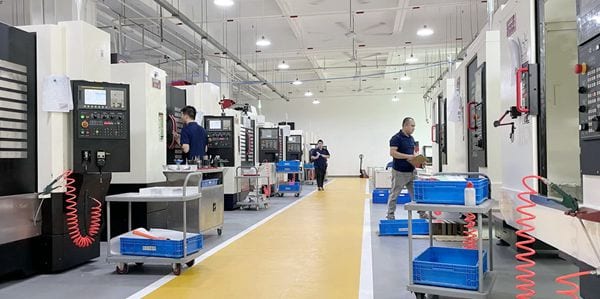
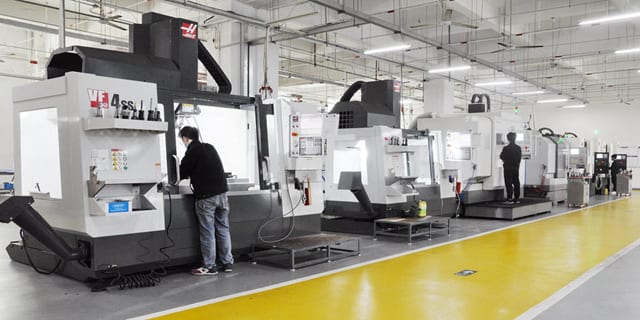
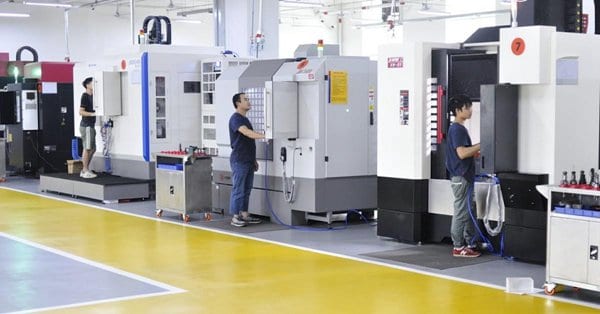
A deposit feels like the buyer taking all the risk, and sometimes it is abused that way. But understand what happens on the shop floor the moment you approve an order. The supplier buys raw stock — billet, plate, bar — often cut to your job specifically, which means it is not freely resellable if you walk. They schedule machine time, which is the scarcest resource in any shop; a booked 5-axis centre that sits idle because a customer vanished is pure loss. On a die-casting job they may commit to a mould that costs more than the entire first production run.
So when a supplier asks for 30 to 50% down, they are usually asking you to cover the costs they cannot recover if you disappear — not asking you to finance their business. A shop that demands 100% before production, or that cannot explain what the deposit funds, is the one to question. A shop that wants a reasonable deposit and is willing to gate the balance on your inspection is behaving normally. The deposit is the supplier's protection against a buyer who ghosts; the staged balance is your protection against a supplier who under-delivers. Both are legitimate. Whether an offshore shop is even the right call for your part is a separate decision — the trade-offs of domestic versus overseas CNC machining cover the cost and geography side of that.
The instruments, and the honest trade-off of each
Here is where the real decisions live. Each of these does something different, costs something different, and fails in a different way. There is no instrument that removes risk; there are instruments that move it, price it, or split it.
Deposit plus balance (the workhorse)
You pay a deposit up front and the balance at a defined point — before shipment, after first-article approval, or against shipping documents. A 30/70 split leaves more of your money contingent on the supplier performing; a 50/50 split shares the up-front burden more evenly and is common on jobs with higher material cost. Almost every no-MOQ CNC and sheet-metal order runs this way.
What it is designed to do: cover the supplier's sunk costs while keeping the majority of your money contingent on delivery. What it costs: essentially just the bank wire fee. Friction: low. Where it can still fail: once the deposit is sent it is gone if the supplier defaults; a plain bank transfer has no built-in recourse mechanism, so this structure relies entirely on the supplier being legitimate. That is precisely why the deposit percentage and the vetting matter so much.
Payment against inspection or shipping documents
The balance is released only when a condition is met and documented — a passed inspection, or a specific set of shipping documents (bill of lading, packing list, inspection certificate) presented through banks. In its formal cross-border version this shades into a documentary collection, where banks handle the documents but, importantly, do not guarantee payment or goods.
What it is designed to do: tie your money to evidence rather than to a promise or a date. What it costs: inspection fees, possibly a third-party inspector, and bank document-handling charges. Friction: medium — someone has to define what \"passed\" means, in writing, before production. Where it can still fail: documents can be correct while the goods behind them are not, and a documentary collection does not carry a bank's payment guarantee the way a letter of credit does. Confirm with your bank exactly what any documentary arrangement does and does not cover.
Third-party escrow
A neutral third party holds your money and releases it to the supplier when agreed conditions are met. Some B2B marketplaces bundle this in; standalone escrow services exist for larger deals.
What it is designed to do: stop either party from having both the money and the goods at the same time. What it costs: an escrow fee, typically a percentage of the transaction, plus setup time. Friction: medium to high — both parties must agree on the release conditions and trust the escrow provider. Where it can still fail: the release conditions are only as good as how precisely you wrote them, disputes can stall funds, and the escrow provider itself must be reputable and reachable in a jurisdiction that means something to you. Escrow shifts trust from the supplier to the escrow agent; it does not remove it.
Letter of credit (L/C)
A bank instrument, common on large international orders, under which the buyer's bank commits to pay the supplier once the supplier presents documents that exactly match the terms in the L/C. The ICC's Incoterms and documentary-credit rules underpin how these are written and interpreted internationally.
What it is designed to do: substitute a bank's payment commitment for the buyer's, and tie release to a strict documentary standard. What it costs: bank fees on both sides, and real administrative overhead. Friction: high — L/Cs are unforgiving; a single mismatched document can hold up payment, and amendments cost money and time. Where it can still fail: an L/C is a promise about documents, not about part quality — conforming paperwork can still accompany bad parts. It generally only makes sense above a transaction size where the fees are justified. Your bank's trade-finance desk is the right party to tell you whether an L/C fits your deal and country; national export-credit and trade bodies such as the U.S. government's trade resources publish plain-language explainers worth reading first.
Platform-held payments
Marketplaces like Xometry, Fictiv or Hubs, and large B2B platforms, hold funds and release them on their own terms, folding a form of escrow and dispute resolution into the platform. Working directly with a shop such as Sendot trades that built-in intermediary for a direct relationship and usually a better price.
What it is designed to do: give buyers a dispute process and a familiar checkout without arranging escrow themselves. What it costs: it is priced into the platform's margin, so you generally pay more than dealing direct. Friction: low at checkout, but you are bound by the platform's dispute rules, which you did not write. Where it can still fail: the platform decides disputes on its terms, resolution can be slow, and you have less direct leverage over the actual manufacturer. Convenient for small, standard orders; less suited to complex parts where you want a direct engineering conversation.
Comparison: which instrument for which order
| Instrument | Best for | Typical cost | Friction | Who it favours | Main way it still fails |
|---|---|---|---|---|---|
| Deposit + balance | No-MOQ CNC, sheet metal, most first orders | Wire fee only | Low | Balanced, if split and gating are sensible | Deposit is unrecoverable on default; no built-in recourse |
| Payment against inspection/documents | Buyers who can define acceptance precisely | Inspection + bank doc fees | Medium | Buyer, modestly | Good documents can mask bad goods |
| Escrow | Mid-to-large deals, new relationship | % escrow fee | Medium–high | Both, via a neutral holder | Vague release terms; disputes stall funds |
| Letter of credit | Large international orders, heavy tooling | Bank fees both sides | High | Both, at a price | Guarantees documents, not part quality |
| Platform-held | Small, standard, one-off orders | Baked into platform margin | Low at checkout | Platform first | You are bound by rules you did not write |
Read the table as a ladder that climbs with transaction size and unfamiliarity. A $2,000 CNC prototype run does not warrant a letter of credit; the fees and paperwork would dwarf the risk. A $60,000 die-casting programme with a new supplier is exactly where escrow or an L/C starts earning its cost. Match the weight of the instrument to the weight of what you could lose.
A concrete milestone structure you can propose
Here is a stage-linked structure that maps payment to what is actually happening in the shop. Adjust the percentages to your order and your risk tolerance, but keep the sequence — the point is that each release corresponds to something you can verify.
- Deposit on order confirmation (30–50%): funds raw material purchase and reserves machine time. For tooling jobs, this stage is often split further to cover mould fabrication.
- Material bought / production started: supplier confirms material is in and cutting has begun. On larger jobs, ask for a short update or photo; on a die-casting job this is where the tool build milestone sits.
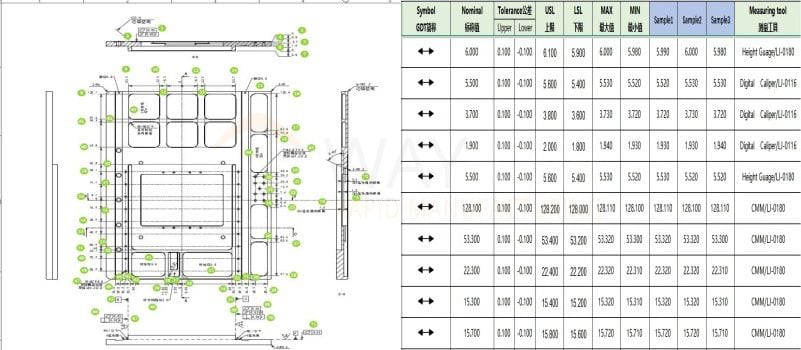
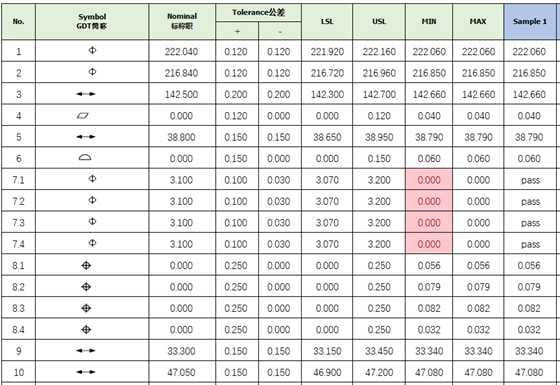
- First article approved: the supplier produces one part, runs CMM inspection, and sends a first-article inspection (FAI) report and material certificates. You do not release the balance until you have read and accepted this. This is the single most important gate in the whole structure.
- Balance before or against shipment (the remaining 50–70%): paid once the first article is approved and, ideally, against shipping documents so payment and dispatch are linked. This keeps the majority of your money contingent on the supplier actually delivering conforming parts.
This is close to how Sendot works in practice: milestone payments with a first-article inspection — CMM data, an FAI report and material certificates — before the balance. It is a normal, reasonable structure, and it is worth being clear-eyed about what it does. It ensures you see measured evidence of a conforming part before your final payment, and it gives the supplier the deposit they legitimately need to start. It does not, and cannot, eliminate risk on its own; it works because it is paired with a supplier you have actually vetted. If you want to see the inspection evidence that gates step three, our CNC machining service page details the CMM inspection, FAI reporting and material-certificate documentation that come standard.
Common mistakes that cost buyers money
These are the ones that recur, and every one of them is avoidable.
- Paying 100% up front to \"get a discount.\" A discount for full prepayment is you being paid a small amount to take on all the risk. On a first order with a new supplier, it is rarely worth it.
- Releasing the balance on a promised ship date instead of on inspection. A date is not evidence. Gate the balance on an approved first article and, where possible, on shipping documents — not on a calendar entry.
- Not defining \"acceptable\" before production. If your acceptance criteria and inspection method are not written into the order, a document-release or escrow structure has nothing solid to release against. Define tolerances, finish and inspection method up front.
- Using a heavy instrument for a light order. Arranging a letter of credit for a $3,000 prototype run burns fees and weeks for protection you did not need. Match the instrument to the exposure.
- Sending money to an account name that does not match the company. A mismatch between the supplier's legal entity and the beneficiary account is one of the oldest warning signs in cross-border trade. Confirm banking details through a channel you initiated, never solely from an emailed invoice.
- Treating payment terms as a substitute for vetting. The best structure in the world only limits the damage a bad supplier can do. It does not stop you choosing one.
Frequently asked questions
Is a deposit request a red flag?
30/70 or 50/50 — which split should I ask for?
Do I need a letter of credit or escrow for a small order?
What is a first-article inspection and why gate payment on it?
Does a good payment structure protect my money?
KEY TAKEAWAYS
- Pay in stages tied to verifiable events, not in one lump and not on a calendar date.
- A 30 to 50% deposit is normal — it funds material and machine time the supplier cannot recover if you vanish.
- Gate the balance on an approved first-article inspection with CMM data and material certificates.
- Scale the instrument to the exposure: wire for small runs, escrow or a letter of credit for large tooling deals.
- No instrument removes risk — confirm the specifics with your bank or a trade-finance professional, and vet the supplier before you pay.
Structure the payment well and you limit the damage any single thing going wrong can do. But the structure is the seatbelt, not the driver — it works alongside a supplier you have properly checked out, clear written acceptance criteria, and inspection evidence you can actually read. Get those three right and an overseas manufacturing relationship stops being a leap of faith and becomes a series of small, verifiable steps.
Manufacturing next step
Apply this guidance to your part
Continue to the relevant service page for process scope and buyer inputs. If your design is ready, send the current files for engineering review and quotation.
Related manufacturing resources
Continue with the process or project stage most relevant to this topic: