
What is a Screw Thread?
A screw thread is the spiral-shaped line you see on screws, bolts, or the inside of a nut. It looks like a spiral line wrapped around a cone or cylinder. Threads enable two components to be joined in a secure manner or, in some cases, to form a tight seal.
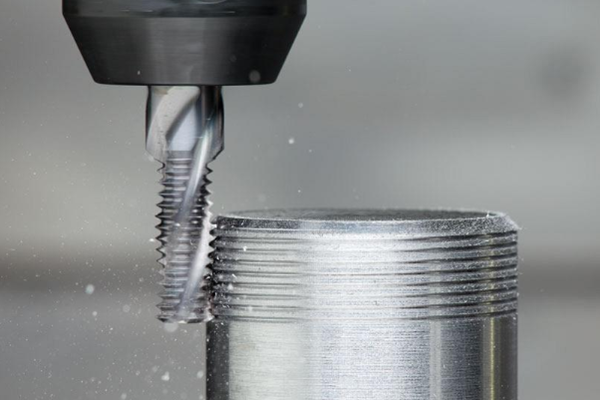
Screws may also be external (around the outside of a screw or bolt) or internal (around the inside of a nut or hole). They are designed in a way that enables them to transform turning motion into a tightening force. Simply put, threads give screws and bolts their gripping power. They are available in numerous shapes, sizes, and standards, based on the strength of the connection required and whether it should be sealed or not.
We can use screw threads in various applications, and it is a ridge wrapped around a cone or cylinder. The screw thread is in the form of a helix. The lead of a screw thread is the linear distance the screw can travel in one revolution, and the mechanical advantage of screw threads depends on their lead.
There are two common forms of threads: straight threads and tapered threads.
- Straight threads have a parallel profile that remains the same diameter throughout the part.
- Tapered threads taper along with the thread profile and become smaller in diameter as the part moves down.
Geometric Parameters of Thread
The size, shape, and performance of a thread are defined by its geometric features. Key measurements determine how well a screw fits, holds, and functions in real-world use. In this section, we’ll discuss the geometric parameters of a thread.
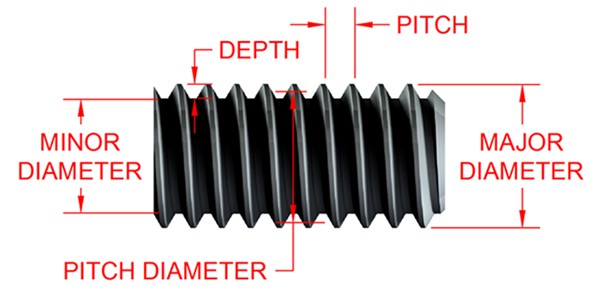
1. Outer Diameter (Major thread diameter)
Major and minor diameters are geometric parameters of a thread. Major diameter (outside diameter) is the largest material diameter of a gear tooth or thread feature. Outside or external thread diameter means the diameter of a screw and includes a raised helix height around the thread. Using a clipper rule or a thread pitch gauge, you can measure the outside diameter.
The major diameter, or outside diameter, is measured using an external thread screw. A caliper can measure the outside diameter of a female thread (or inside diameter, respectively). The outer diameter of the male thread is calculated by using a clipper. A thread pitch gauge helps you measure female threads, and male threads with clippers save you time and money.
2. Inner Diameter (Minor thread diameter)
Minor diameter can be defined as an imaginary cylinder that can touch the roots of the thread crests (a prominent part of a thread) of an internal thread or the roots of an external thread.
Special equipment is required to measure major and minor diameters. Minor diameter is a screw’s diameter that can be measured at the root of the thread at the intersect area of the screw or the base of the thread.
3. Pitch Diameter (Effective Diameter)
Effective, or pitch, diameter is the diameter of an imaginary coaxial cylinder that can intercept the surface of the thread. Pitch diameter can cross so that the intercept on a cylinder generator is at the point where pitch diameter meets the opposite flanks of the effective thread groove. The thread groove is equal to half of the nominal pitch of the screw thread.
You can use a thread pitch gauge tool to check and identify the thread diameter and size. The thread pitch gauge tool can prove helpful to calculate and measure the number of threads accurately within a given distance, and you can try various gauge tools for this purpose.
4. Pitch
The pitch of the thread, or we can say the thread pitch, is the distance from a point on the same screw thread to a corresponding thread.
The thread pitch will be on the next thread that can be measured parallel to the axis. It should be between corresponding points on an adjacent surface in the same axial plane.
5. Lead
We can define the distance a screw thread can advance axially in one turn. The lead and pitch are the same on a single-threaded screw, while the lead is twice the pitch on a double-threaded screw. The lead is three times the pitch on a triple-headed screw.
6. Tooth Angle
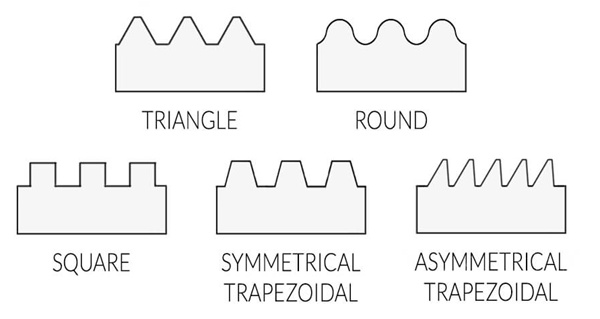
Tooth angle terminology refers to the shape and geometry of a thread. Threads can be found in various shapes and styles. The tooth angle may be trapezoidal, square, or triangular.
7. Threaded Angle
The angle, which is included between the sides of the thread measured in an axial plane, is called the threaded angle or angle of the thread.
8. Helix Angle
The helix angle determines how far the screw will move with each rotation. A smaller helix angle means the thread wraps more tightly with a stronger holding power but slower movement, while a larger helix angle allows for quicker linear movement.
Different Types of Screw Threads
There are different types of threads found, and some main types of threads are parallel threads, including BSPP, UN/UNF, and metric parallel. The second type of thread is tapered threads, in which metric tapered, BSPT, and NPT/NPTF threads are included.
1. Metric Threads or International Threads
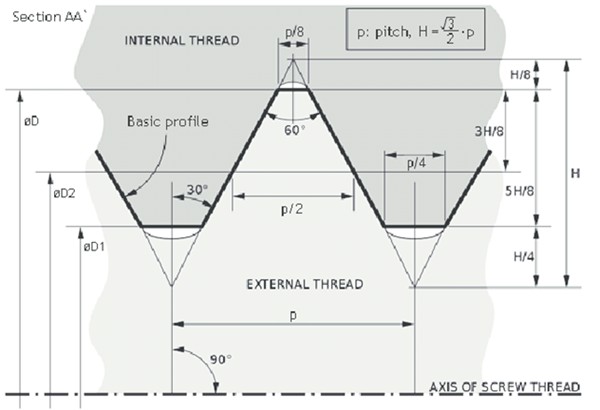
Metric threads, or international threads, were the first international standards, and we use metric threads for general-purpose screw threads worldwide. The “M” in the metric threads indicates the nominal outer diameter of the screw thread.
“M” in a metric thread has also indicated the diameter of the smooth-walled hole. ISO metric screw thread is a global thread, and the fine thread has a small pitch compared to the coarse thread.
2. British Standard Threads
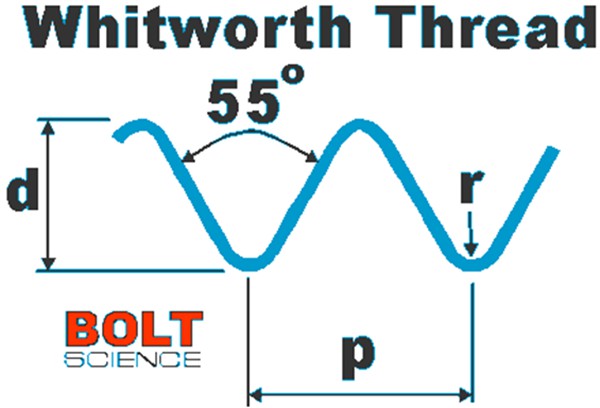
British standard Whitworth (BSW) thread was devised and specified by Joseph Whitworth. It is an imperial-unit-based screw thread standard and was the world’s first national pipe tapered thread standard.
These standard threads are one of the main types of threads and have coarse pitches and bases of many other standards, such as BSCon, BSF, and BSCopper. BST is used for special purposes, such as line adjustment, and can be found on bolts.
BSF (British standard thread with fine pitches) increases vibrations in automobile and aero work and line adjustment. These types of threads can also be used for the internal thread size and external thread size of iron and steel pipes, where great strength is required. The thread form of BST is as follows:
- British standard pipe parallel thread (BSPP)
- British standard pipe tapered thread (BSPT)
| BSP Thread Size | Outside Diameter mm/inch | TPI |
| 1/16 Inch BSP | 7.7 mm / 0.304″ | 28 |
| 1/8 Inch BSP | 9.7 mm / 0.383″ | 28 |
| 1/4 Inch BSP | 13.16 mm / 0.518″ | 19 |
| 3/8 Inch BSP | 16.66 mm / 0.656″ | 19 |
| 1/2 Inch BSP | 20.99 mm / 0.825″ | 14 |
| 5/8 Inch BSP | 22.99 mm / 0.902″ | 14 |
| 3/4 Inch BSP | 26.44 mm / 1.041″ | 14 |
| 7/8 Inch BSP | 30.20 mm / 1.189″ | 14 |
| 1 Inch BSP | 33.25 mm / 1.309″ | 11 |
| 1-1/4 Inch BSP | 41.91 mm / 1.650″ | 11 |
| 1-1/2 Inch BSP | 47.80 mm / 1.882″ | 11 |
| 2 Inch BSP | 59.61 mm / 2.347″ | 11 |
| 2-1/4 Inch BSP | 65.71 mm / 2.587″ | 11 |
| 2-1/2 Inch BSP | 75.18 mm / 2.96″ | 11 |
| 3 Inch BSP | 87.88 mm / 3.46″ | 11 |
| 4 Inch BSP | 113.03 mm / 4.45″ | 11 |
| 5 Inch BSP | 138.43 mm / 5.45″ | 11 |
| 6 Inch BSP | 163.83 mm / 6.45″ | 11 |
3. Unified Thread Standard (UTS)
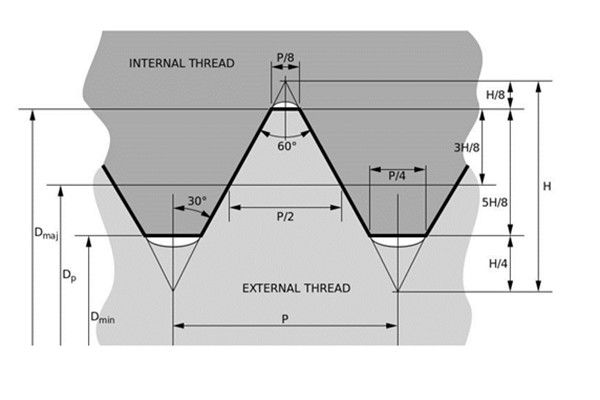
The unified thread standard is one of the different types of threads that have rounded crests and roots. Unified threads consist of three classes:
- This thread type is used for applications requiring liberal tolerance for easy assembly.
- This class of unified threads is commonly used for general applications.
- The last class of unified standard thread is used where the accuracy of thread elements and closeness of fit are essentially required or important.
Unified threads standard (UTS) is the main standard thread type for nuts and bolts and has the same 60° profile as the ISO metric screw thread.
The unified threads standard is the one thread form used in three countries, i.e., Canada, the United States, and Great Britain, under an agreement with the included angle of 60° so that they can easily exchange machinery and thread-identifying tools. The unified threads standard is a general-purpose screw thread controlled by ANSI/ASME in the USA.
4. “V” Shape Threads
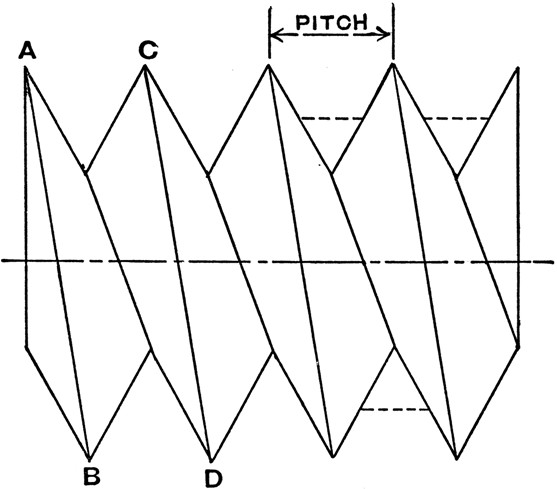
“V”-shaped threads are widely used, and you can cut them with a lathe machine, tap, or die. The thread shape is like the English alphabet V, as their name reflects the form of screw threads.
5. Square Threads
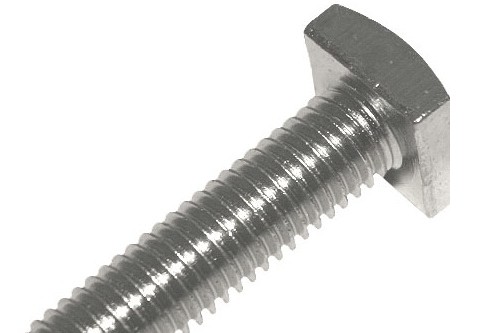
The square thread has high efficiency. It is used to transmit power in high-load applications such as jackscrews and leadscrews. Square thread is a common screw thread form among the different types of threads, and its name is due to a square cross-section of the thread.
The square thread consists of the most efficient thread form, but it is not easy to fabricate square threads. The square thread has the lowest friction, and it is widely used due to its high efficiency. The types of square threads can be found on tools, spindles, feed mechanisms of machine tools, and screw jacks.
Square thread type is less strong than V-thread, but it can offer less frictional resistance to motion than the Whitworth thread.
6. Acme Threads
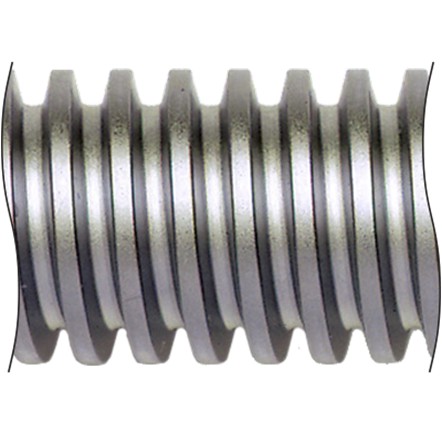
Acme thread is mostly used for brass valves, bench vises, and screw-cutting lathes. It is a transformation of the square thread and can easily be produced. The Acme thread type is stronger than the square thread. There are three types of general-purpose Acme threads: 2G, 3G, and 4G. Each class is used for the assemblies and clearance on all standard size diameters.
7. Knuckle Threads
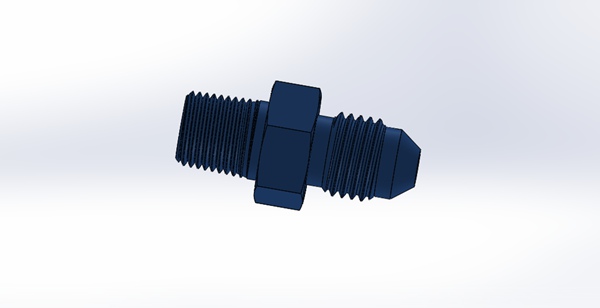
Knuckle thread is a thread form of the screw thread terminologies and can be used for rough work. It has a rounded top and bottom. It is sensitive and can easily be damaged and dirtied. Knuckle threads are an adaptation of the square thread, and they can easily be cast and rolled. The angle of the knuckle thread is 30 degrees. Knuckle threads are one of the different types of threads used in necks of glass bottles, coupling gears, valves, fittings, slides, hydrants, large molded insulators used in the electrical trade, and railway carriage couplings.
8. Buttress Threads
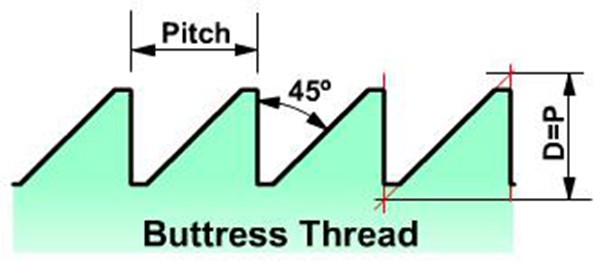
Buttress threads can be referred to as two-thread profiles:
- Sawtooth thread is a type of leadscrew used in machinery and known as a breech-lock thread form. It allows the thread to withstand great loads in one direction. It has low friction.
- Buttress pipe thread is a type of trapezoid tapered pipe thread used in the oil industry as a hydraulic sealing thread form.
Buttress threads have the advantage of both V-threads and square threads and are used to transmit power when it is transmitted in one direction. It has the same strength as most threads of V-thread and has low frictional resistance characteristics of the square thread.
The height of buttress thread engagement is 0.6p and has a clearance angle from normal to the axis of 45 degrees. Common examples of buttress nuts and rods are airplane propeller hubs, breech assemblies of large guns, and columns for hydraulic presses.
9. Worm Threads
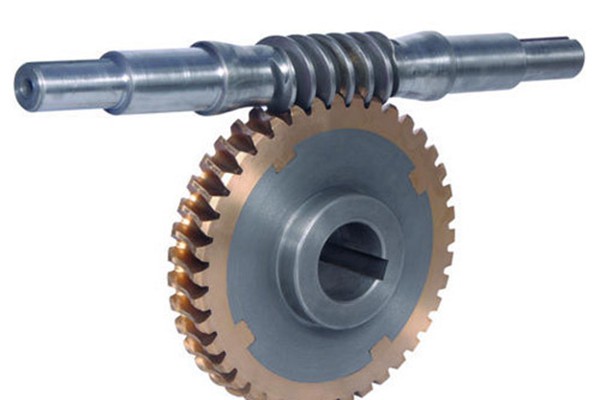
Worm threads are one of the different types of threads similar to Acme threads, as their shape also has 29 degrees. One difference is that they are deeper than acme threads. We use worm threads in the wormwheels of motor vehicles. It can transfer at 90 degrees because three teeth of the worm wheel can fit into the shaft while using a shaft with worm threads. They can work well.
10. Single and Multi-Threads
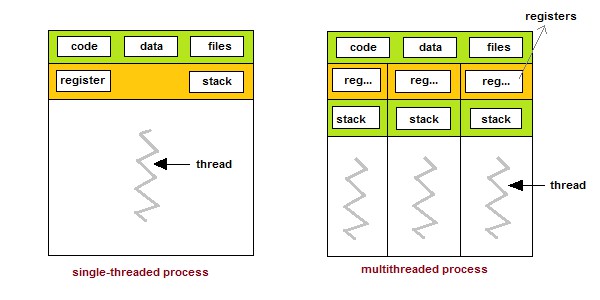
Some independent and separate threads are also found in screw thread terminology and can run along with a piece of work; therefore, single-threaded screws and multi-started threaded screws are used in some pieces of work.
- The single-threaded screw refers to the screw when one completely turns around the bolt or screw is called a single-threaded screw. It is also called a start, and you can have a single start, two starts, or three starts.
- The multiple-threaded screw refers to a screw that has more than one thread running along its length. We can use multi-start threads in cases where fast motion or movement is required.
11. Right-Hand Threads
Right-hand threads are the standard type of screw threads and are the ones most frequently used in everyday applications. These standard threads tighten when you turn them in a clockwise direction, which is why they are often called clockwise threads. Almost all everyday screws, bolts, and nuts use this type of thread.
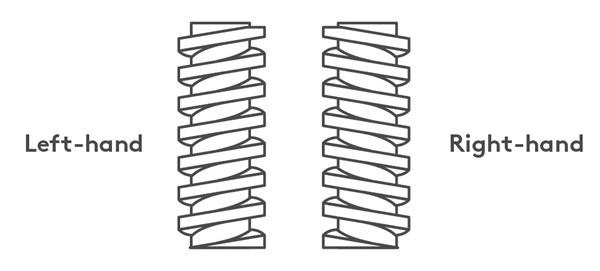
12. Left-Hand Threads
The left-hand threads are less popular, and they tighten when they are turned to the left. Unlike regular screws, they tighten when turned in the opposite direction. This left-hand configuration is used in special cases, such as machinery or tools, where regular right-hand threads might loosen because of rotation or vibration.
Important Thread Terms Briefly Explained
To understand screw threads fully, you need to know the key thread terminology that defines their geometry and performance. Here’s a thread glossary to work with:
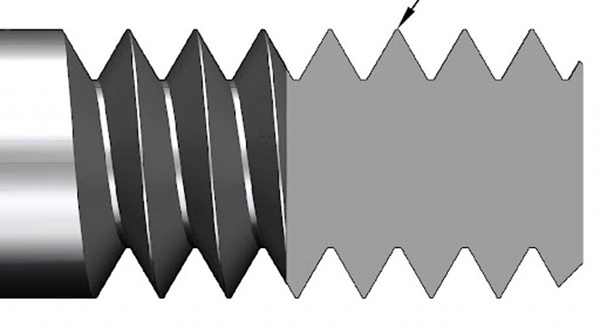
- Internal Threads: They are made to match external threads so that screws or bolts can fit securely inside. They are commonly called the female thread.
- External Threads: External threads are also called the male thread because they have spiral crests outside the screw. They are designed to fit into matching female internal threads, like those inside a nut or a hole, to hold two parts tightly together.
- Spaced Threads: Spaced threads have wide gaps between each ridge. This design helps them grip softer materials like wood or plastic, making them less likely to strip or wear out.
- Lag Screws: These are heavy-duty screws with thick, deep threads. They are commonly used in wood construction and other strong materials where extra holding power is needed.
- Machine Screw Threads: These are fine, uniform threads made for fitting work. They are often used in machines and metal parts where a strong and accurate fit is needed.
- Thread-Forming Screws: Thread-forming screws don’t cut the material but instead press and shape it to form threads. They are used in plastics and soft metals to create a tight, vibration-resistant fit.
- Self-Tapping Screws: Self-tapping screws, just like their name implies, cut their own threads as they are driven into a material or object. This means you don’t need to pre-drill a hole before using them, which saves time and effort.
- Crest: The top or outermost surface of a thread.
- Root: The bottom surface between two thread flanks.
- Flank: The surface that connects the crest and root of a thread.
How to Identify Types of Threads?
When working with screws, bolts, or pipes, proper thread identification is important to make sure parts fit and work safely. By checking different features, you can place the threads into the right group using thread classification.
You can follow these basic steps to figure out the type of thread you are working with:
Step 1: Male Thread vs. Female Thread
Firstly, check if the thread is external or internal. Threads on the outside of a part, such as a bolt, are called male threads. Threads on the inside of a hole or fitting, like in a nut, are known as female threads.
Step 2: Tapered Thread vs. Parallel Thread
The next thing is to look at the shape. A tapered thread gets thinner as it goes in, making the fitting firm and strong. A parallel thread has the same diameter all the way through, which requires an extra round nut for proper fitting.
Step 3: Determine the Pitch of the Thread
Check the thread Pitch as it helps you know if the thread is coarse or fine.
Step 4: Measure Thread Size
Use a caliper to measure the thread diameter. For male threads, measure the outer diameter. For female threads, measure the inner diameter. This measurement gives you the thread size.
Step 5: Designate Thread Type Standard
Finally, check which standard the thread follows. Common ones include metric (mm-based) and imperial (inch-based) threads. Pipe threads like NPT or BSP also have their own standards.
Important Tips to Choose the Right Screw Thread
In order to choose the right thread, you need to pay special attention to some specific characteristics of the thread. It will provide you with the right strength and ensure better performance for various applications. Some of these tips are listed below.
You cannot use all types of screw threads for all applications. Each type is specifically designed to perform its specific task and is manufactured with various materials to perform different functions.
Some screw threads may need sharp designs made for drilling directly, while on the other side, some may require pre-drilled holes for their proper working.
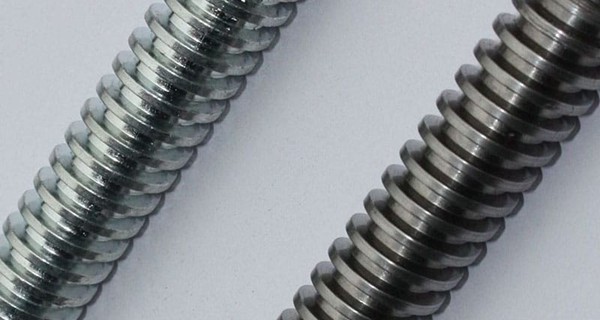
Thread spacing can vary in other screws, which are very important for different characteristics of screw threads.
Application of Threads
Threads are widely used, and they play important roles across many industries. Common thread uses include joining parts together, transferring motion, and sealing connections.
Machining
In machining, threads are important for assembling tools, parts, and machines. Threaded fasteners, spindles, and lead screws ensure accurate alignment and controlled motion in lathes, mills, and CNC machines.
Construction
Construction projects depend heavily on threaded fasteners like bolts, screws, and anchors. They hold structural elements together, connect pipes, and provide stability in heavy-duty applications such as scaffolding, bridges, and buildings.
Automotive
In the automotive industry, threads are used for assembling engines, chassis, and body components. They ensure vehicle safety and durability. They also work great to secure parts under vibration and heat, like wheel bolts, engine screws, etc.
Aerospace
Aerospace applications demand high-level thread functionality that can withstand heavy stress. Screw threads like the unified thread and metric threads are used to assemble and connect structural parts, components, and aircraft systems. Most fasteners used for aircraft contain these screw threads, and they have strong vibration resistance and durability to withstand harsh conditions, keeping interior features and aerospace parts like the engine well secured.
Consumer
In the consumer sector, threads are used for bottle caps, jars, light bulbs, and home appliances. They allow easy opening, closing, and secure fastening in products used daily.