Passivation of Stainless Steel: Process, ASTM A967 & Benefits
Passivation is a chemical treatment — using nitric or citric acid — that removes free iron and contaminants from a stainless steel surface and lets the protective chromium-oxide layer re-form. It boosts corrosion resistance without changing the part's appearance or dimensions, and is specified by ASTM A967.
See our parts finishing service and stainless steel machining guide, or CNC machining stainless steel.
Key takeaways
- Passivation removes free iron left on the surface from machining and enriches the chromium-oxide (passive) layer that makes stainless 'stainless'.
- It improves corrosion resistance without adding a coating — no change to color, finish or dimensions.
- Two common acids: nitric (traditional) and citric (safer, greener, increasingly preferred); both per ASTM A967 (aerospace also uses AMS 2700).
- Passivation is not a coating and not the same as electropolishing; it only conditions the existing surface.
- Get passivated stainless parts with your machining — request a quote.
What is passivation?
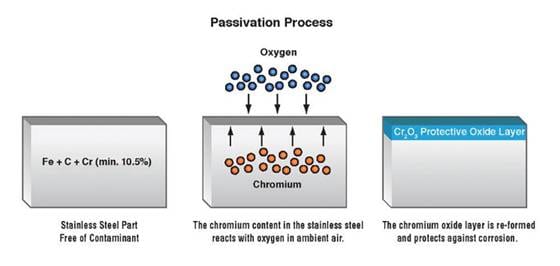
Stainless steel resists corrosion because its chromium content (min. ~10.5%) forms a thin, self-healing chromium-oxide layer. Machining, handling and tooling can smear free iron onto the surface, which rusts and can compromise that passive layer. Passivation is a chemical bath (nitric or citric acid) that dissolves the free iron and contaminants, letting a clean, chromium-rich oxide layer re-form uniformly across the part.
Why passivate stainless steel?
- Better corrosion resistance: removes rust-prone free iron and maximizes the passive layer.
- No dimensional or cosmetic change: it conditions the surface rather than coating it.
- Cleaner surface: removes machining contaminants — important for medical, food and marine parts.
- Standards compliance: often required per ASTM A967 or AMS 2700.
The passivation process
- Clean/degrease — remove oils, coolant and swarf (passivation is not a cleaner).
- Acid bath — immerse in nitric or citric acid solution for a controlled time and temperature.
- Rinse — thoroughly remove acid.
- Dry and (optionally) test — verify per ASTM A967 (e.g. salt spray, humidity, or copper sulfate test).
Nitric vs citric acid passivation
| Nitric acid | Citric acid | |
|---|---|---|
| Tradition | Long-established | Newer, growing fast |
| Safety / environment | Hazardous, fumes, disposal | Safer, greener, easier disposal |
| Effectiveness | Proven across grades | Equivalent or better; faster, lower temp |
| Standard | ASTM A967 / AMS 2700 | ASTM A967 / AMS 2700 |
What passivation is not
Passivation is not a coating, not a color/finish change, and not plating. It also isn't electropolishing, which electrochemically removes a surface layer to smooth and brighten it (though electropolishing also passivates as a side effect). Passivation simply cleans and conditions the existing stainless surface.
Applications
- Medical devices and surgical instruments (biocompatible, corrosion-critical)
- Food, dairy and pharmaceutical equipment (hygienic surfaces)
- Marine, aerospace and precision components exposed to corrosion

Frequently asked questions
What does passivation do to stainless steel?
What is ASTM A967?
Nitric or citric acid passivation — which is better?
Does passivation change the part's dimensions or color?
Is passivation the same as electropolishing?
Sources & further reading: ASTM A967 — passivation standard · British Stainless Steel Association.
Manufacturing next step
Apply this guidance to your part
Continue to the relevant service page for process scope and buyer inputs. If your design is ready, send the current files for engineering review and quotation.
Related manufacturing resources
Continue with the process or project stage most relevant to this topic: