Sheet Metal Bending: Methods, Bend Radius & Springback
TL;DR
Sheet metal bending forms a flat blank on a press brake by pressing a punch into a V-die. Air bending is the default because one tool set makes any angle; bottoming and coining trade flexibility for accuracy. The three things that decide whether a bend works are the bend radius (keep it at least equal to the material thickness), springback (the metal always relaxes back a little), and grain direction (bend across it, not along it).
- Air bending is the default: the punch never bottoms out, so one tool set makes any angle — but it springs back most.
- Bottoming and coining force the metal into the die for accuracy and less springback, at higher tonnage and a tool set per angle.
- Minimum bend radius ≥ material thickness is the safe starting rule; tighter risks cracking the outside of the bend.
- Springback is always present — the brake overbends to compensate; harder and thicker material springs back more.
- Bend across the grain. Bending along the rolling direction is the most common cause of a cracked bend.
- Sendot bends ${SPECS.thickness} sheet with no MOQ, simple parts in ${SPECS.lead}.
Bending is where sheet metal parts are won or lost. Cutting a flat blank is easy and forgiving; bending it introduces material behaviour — springback, grain direction, and the physical size of the tooling — that a flat drawing does not show. This guide covers how bending actually works and the rules that keep parts manufacturable.
For the flat-pattern maths — bend allowance, bend deduction, and how to calculate the K-factor — see our sheet metal gauge chart and bend allowance guide. This article is about the forming itself. See also our sheet metal fabrication services.
What is sheet metal bending?
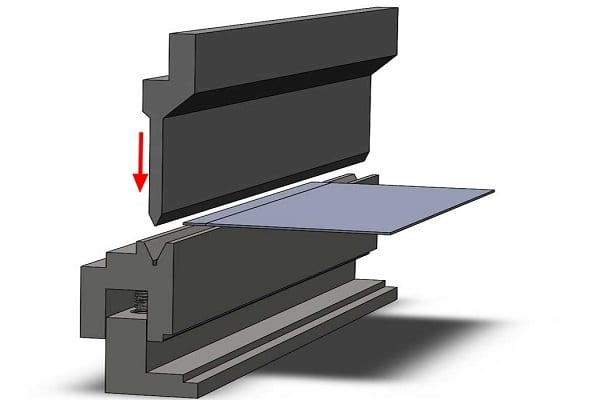
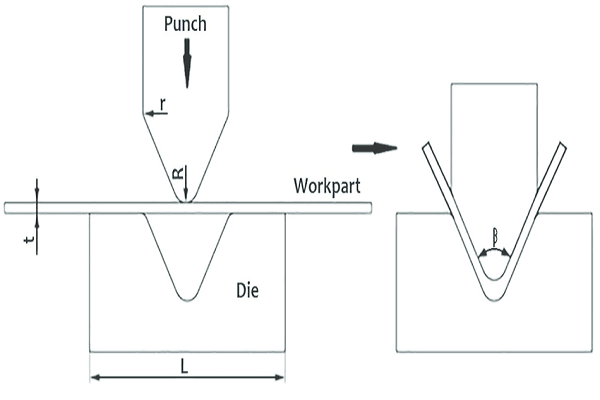
Sheet metal bending is the process of forming a flat blank into an angled part by pressing it against a die, permanently deforming the metal along a straight line. On a press brake, a punch descends into a V-shaped die with the sheet between them. The outside of the bend stretches, the inside compresses, and somewhere between them sits a neutral axis that does neither — which is why the flat blank must be longer than the sum of the finished legs, and why bend allowance exists at all.
The three bending methods
| Air bending | Bottoming | Coining | |
|---|---|---|---|
| Punch contact | Never reaches the die floor | Presses sheet to the die walls | Forces sheet fully into the die |
| Angle set by | How far the punch descends | The die angle | The die angle |
| Tooling | One set makes any angle | A die per angle | A die per angle |
| Tonnage | Lowest | Higher | Highest — several times air bending |
| Springback | Most | Less | Least |
| Accuracy | Good | Better | Best |
| Use when | Almost always — the default | Repeatable angle matters | Tightest radius and angle control |
Air bending is the default, and the reason is economic rather than technical: because the angle is set by punch depth rather than by the die, one tool set produces any angle. A part with 30°, 90° and 120° bends needs no tool changes. It springs back the most, but the brake simply overbends to compensate.
Bottoming presses the sheet against the die walls, so the die's angle sets the part's angle — more repeatable, less springback, but a tool set per angle. Coining goes further, forcing the metal into the die hard enough to plastically deform it through its whole thickness. It gives the tightest radii and almost no springback, at several times the tonnage. Coining is a specialist choice, not a default.
Bend radius: the rule that stops cracks
Keep the inside bend radius at least equal to the material thickness. That is the safe starting rule. The outside of a bend is in tension, and the tighter the radius the more it stretches — go too tight and it cracks.
- Softer, more ductile material (5052 aluminum, mild steel) tolerates tighter radii.
- Harder or tempered material (6061-T6, stainless, hardened steel) needs a more generous radius — 6061-T6 is a well-known cracker at tight radii.
- Thicker material needs a proportionally larger radius.
- Use one radius throughout the part where you can — it means one tool, fewer setups, and a cheaper part.
That last point is the cheapest DFM win in sheet metal: a part with three different bend radii needs three tool setups. A part with one needs one.
Springback: the metal always relaxes
Springback is the elastic recovery that makes a bend open up slightly after the punch lifts. Every bend has it, because only part of the deformation is plastic — the elastic part relaxes back.
It gets worse with harder material, thicker material, and larger bend radii. The fix is not to fight it but to compensate: the brake overbends, so the part relaxes into the angle you asked for. This is routine, but it is why an angle tolerance on a drawing is meaningful and why a first article matters on a new part — the exact compensation is established on the shop floor, not calculated on paper.
Grain direction: the most common cracked bend
Rolled sheet has a grain — a directional structure from the rolling mill. Bend across the grain and the metal accommodates it; bend along it and the outside of the bend is far more likely to crack.
This bites hardest on hardened aluminum and stainless at tight radii. If a part has bends in two directions, they cannot both be across the grain, so put the tighter radius across it and relax the other. If a bend must run along the grain, open up the radius.
Design rules for bendable parts
- Bend radius ≥ material thickness, and use the same radius throughout the part.
- Minimum flange length: a flange must be long enough to sit on the die — too short and there is nothing to hold. Roughly 4× thickness plus the bend radius is a safe starting point.
- Hole-to-bend distance: holes too close to a bend distort into ovals as the metal stretches. Keep them back roughly 2.5× thickness plus the radius, or bend first and drill after.
- Bend relief: add a relief notch where a bend meets an edge, or the metal will tear at the corner.
- Keep bends on one side where you can — flipping the part costs a setup.
- Tolerance the angle, not just the dimension — springback is real and an untoleranced angle invites an argument.
- Watch tool access: a box whose walls are already bent can physically collide with the punch. Bend order is a real constraint, not an afterthought.
For the flat pattern behind all of this — how much material a bend consumes, and the K-factor that predicts it — see the gauge chart and bend allowance guide. For the defects that show up when these rules are broken, see sheet metal defects, and for the broader picture sheet metal design for manufacturability.
Which materials bend well?
| Material | Bending behaviour | Notes |
|---|---|---|
| Mild / cold-rolled steel | Excellent | Ductile and forgiving — the easiest to bend |
| Aluminum 5052 | Excellent | The forming alloy — tolerates tight radii |
| Aluminum 6061-T6 | Poor at tight radii | Cracks readily — open the radius, bend across grain |
| Stainless 304 | Good, springs back hard | Work-hardens; needs more tonnage and overbend |
| Stainless 316 | Good, springs back hard | Similar to 304; corrosion resistance is the reason to pick it |
| Galvanised steel | Good | Coating can flake at tight radii on the outside of the bend |
| Copper / brass | Excellent | Very ductile; soft tooling marks show easily |
If a design needs both tight bends and strength, 5052 bent then used as-is often beats 6061-T6 fought into shape.
Sheet metal bending at Sendot Technology
Sendot Technology cuts, bends, welds and finishes sheet metal in house, so bend order, tooling access, and the flat pattern are worked out together rather than discovered at the brake.
- Materials: mild & cold-rolled steel, stainless 304/316, aluminum 5052/6061, galvanised steel, copper, brass, typically 0.5–6 mm
- Processes: laser cutting, punching, press-brake bending, stamping, TIG/MIG/spot welding, hemming, finishing
- Tolerance: ±0.1 mm on cut features
- Volume: no minimum order — one prototype or a low-volume run
- Lead time: simple laser-cut and bent parts in 3–7 business days
- Free DFM review with every quote — we flag radii, flange lengths, and hole-to-bend distances before cutting metal
Frequently asked questions
What is the minimum bend radius for sheet metal?
What is springback in sheet metal bending?
What is the difference between air bending, bottoming and coining?
Why did my sheet metal part crack when it was bent?
How close can a hole be to a bend?
What thickness of sheet metal can you bend?

Manufacturing next step
Apply this guidance to your part
Continue to the relevant service page for process scope and buyer inputs. If your design is ready, send the current files for engineering review and quotation.
Related manufacturing resources
Continue with the process or project stage most relevant to this topic: